DOCKDNuggets·1d ago
5 Must-Know Python Concepts for AI Engineers
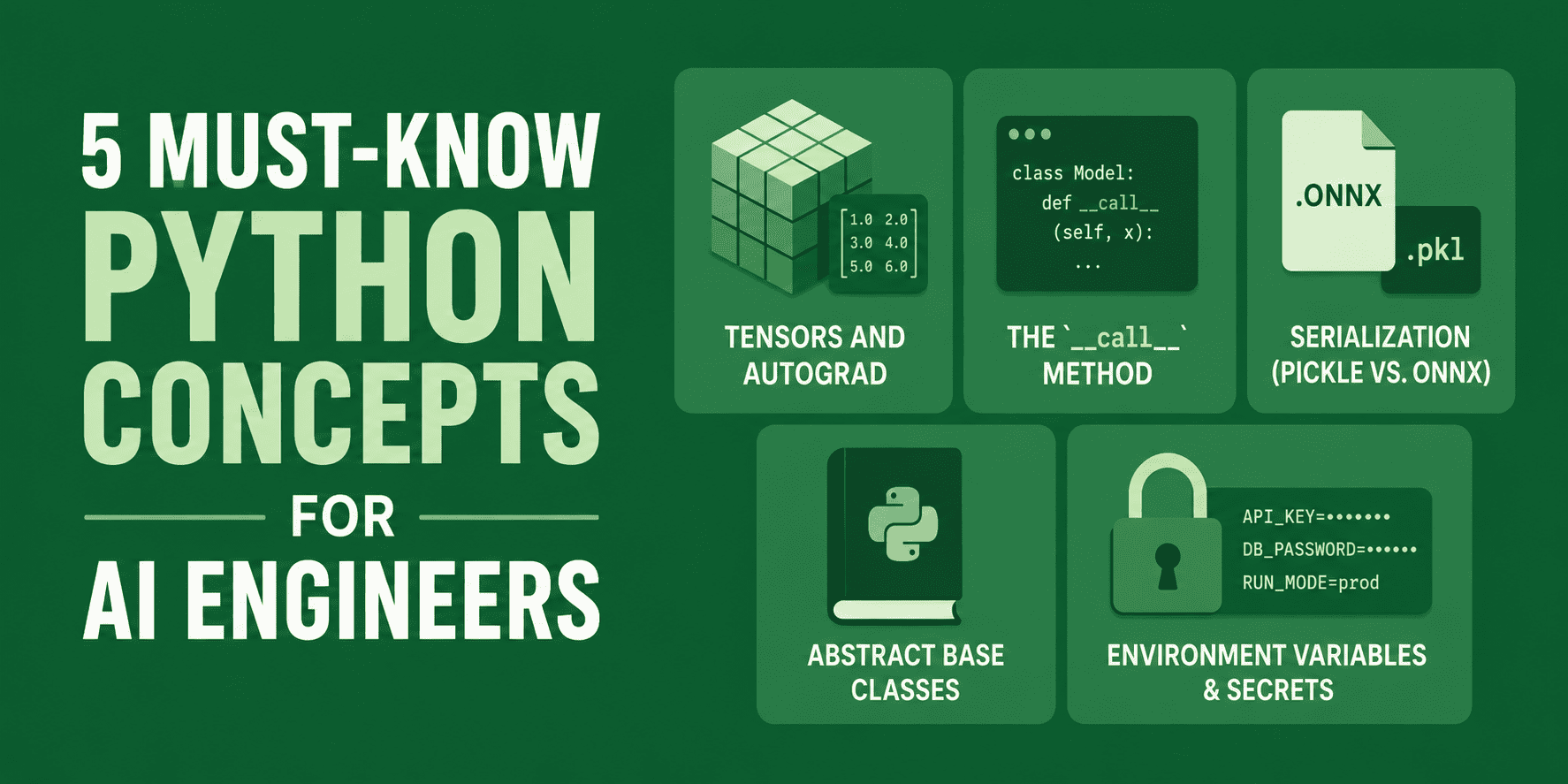
This article explores five essential Python concepts that every AI engineer must master. These concepts are crucial for building scalable, secure, and robust AI systems.
61
This article explores five essential Python concepts that every AI engineer must master. These concepts are crucial for building scalable, secure, and robust AI systems.
A non-technical individual shares their journey of building and deploying their first AI Agent API, "Agentic Finance Beast," using Python, FastAPI, and Mistral AI. This project marks Day 4 of their AI Engineer journey, with future plans including RAG systems and multi-agent financial research.
A user is experiencing production issues with multi-agent systems and has developed a basic chaos monkey framework for agents. They are looking to collaborate with domain experts to enhance the tool, use it for benchmarking, and improve customer experience.
Veo4 addresses the problem of fragmented workflows in multimodal generative AI, where constant context-switching between tools leads to data friction and context loss. They engineered a unified creative engine with a "Context Core" to ensure consistent creative intent across text, image, and video generation.
Contorium introduces a persistent context layer to unify state across multi-tool AI development workflows, addressing context fragmentation. It facilitates orchestration in multi-agent systems, serving as AI-native version control for context in AI engineering.
This paper introduces a practical pipeline to convert text corpora into quantitative semantic signals, employing embeddings, logprob-based evaluation, and noise reduction. The case study applies six semantic dimensions to Portuguese news articles about AI, supporting AI engineering tasks such as corpus inspection and monitoring.
A backend engineer embarked on AI Engineering by building a RAG pipeline from scratch using Python, Gemini API, and ChromaDB. A "chunking bug" during this process provided crucial insights into embeddings and vector search, deepening their understanding of the fundamentals.
Context engineering is the discipline of systematically designing the information environment surrounding a prompt in LLM systems. This skill, expected to replace prompt engineering by 2026, focuses on what the model needs to know to perform well, rather than just what it should do.
This article argues that while LLM cost estimates are a minor concern, rate-limits are the dominant failure mode for LLM applications in production. Rate-limit saturation leads to cascading failures, unlike minor cost discrepancies, and is often overlooked in planning tools.
Agent Harness Engineering is a methodology focused on proactively addressing AI agent errors by engineering solutions to prevent future occurrences of the same mistakes. It emphasizes an iterative approach to improve agent reliability and performance over time.

This article, published in May 2026, argues that SQLite could be the unsung hero for durable AI workflows, helping AI/ML engineers overcome common challenges with complex pipelines and state management. It suggests that understanding SQLite's potential can differentiate successful AI ventures from frustrating, dead-end projects.
This content highlights the critical need for a robust mocking strategy in AI development to overcome challenges like LLM latency, rate limits, and costs during testing and CI/CD. It proposes building a programmable, multi-purpose mocking layer from scratch to ensure reliable and testable AI features.
Este artigo explora modos de falha comuns em sistemas multiagentes em produção, oferecendo padrões de engenharia para mitigá-los. Um cálculo de confiabilidade é apresentado, enfatizando a necessidade de alta confiabilidade individual dos agentes para evitar o colapso do sistema.
This article argues that AI product failures in production often stem from data layer issues—ingestion, retrieval, and memory lifecycle—rather than inherent model weaknesses. It advocates for applying data-engineering discipline to harden this layer, ensuring reliable AI behavior.
The article argues that AI's role in engineering is akin to 3D printing tools, not entire products; AI excels at writing code, but human engineers remain crucial for specifying requirements and making critical trust-model decisions. It highlights a shift from typing to precise specification in software development.
The article argues for AI Engineering as a distinct discipline, necessitated by the non-deterministic nature of AI models compared to traditional software. It illustrates the complexity and potential failure modes within a typical LLM-based system architecture.
Q1 2026 saw major shifts in the AI-native web stack, with LLM pricing redrawn and AI gateways becoming Tier-1 dependencies. These changes necessitate migrations for engineers working with model routing, edge rendering, or AI-assisted coding.
Most AI agent demos impress initially but fail in production, requiring robust engineering beyond simple tool calling. Crucial components like resumable state, observability, and predictable execution are essential to avoid issues such as infinite tool loops and unhelpful user experiences.
The text frames "AI slop" as an engineering problem, not a model problem, suggesting that LLM output quality should be ensured by a validation and retry "harness". Instead of relying solely on prompts, the solution involves treating the model as an unreliable dependency that requires additional validation steps.
This article explores "Agent Skills" in AI engineering, moving beyond simple prompt templates to reveal their crucial role in dynamic context management for Agentic AI. It details the author's evolving understanding and the engineering challenges these Skills solve.