NEWSGoogle DeepMind Blog·9h ago
Fluid, natural voice translation with Gemini 3.5 Live Translate
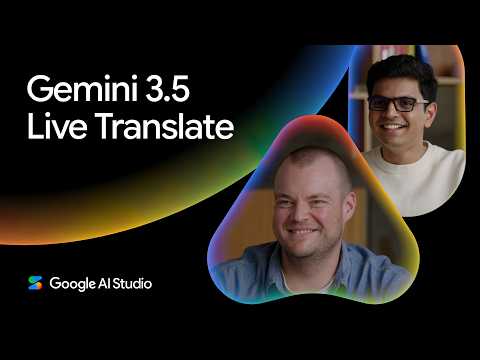
Gemini 3.5 Live Translate provides near real-time, natural speech translation for Google AI Studio, Google Translate, and Google Meet.
60
Gemini 3.5 Live Translate provides near real-time, natural speech translation for Google AI Studio, Google Translate, and Google Meet.
Google introduced Gemini 3.5 Live Translate, a new feature enabling real-time translation. This innovation aims to enhance multilingual communication instantly.
Google employees are internally sharing memes that mock the poor quality of the company's AI. This reflects a sentiment of frustration and skepticism towards the internally developed AI products.
The user observed that a Gemma 4 e4b model extracted from Google AI Edge Gallery on Android performs significantly better and smarter than versions from Unsloth or litertlm, despite being slightly smaller. They question if Google might be hiding a superior, optimized version of the model on Android.
Google's Project Jitro redefines AI coding agents by shifting from task execution to outcome ownership, contrasting with current prompt-based tools. This autonomous system aims to independently achieve high-level development goals.
The author is betting on AI-curated directories even though Google AI Overviews answer similar queries. The challenge is getting users to click through to their sites instead of relying on Google's AI-generated summaries.
This article details Google's latest AI updates announced in May 2026.
Google introduced Gemma 4 12B Unified, an open-source multimodal model designed to understand text, images, audio, and video within a single architecture. Its release also raises interesting questions about Google’s broader AI strategy.
Gemini Spark, Google's 24/7 personal AI agent, was announced at Google I/O 2026. It signifies an architectural shift in AI agent functionality, particularly its capability for long-horizon tasks, which is crucial for developers.
This article recaps the new features unveiled at Google I/O 2026, specifically highlighting important updates for the Gemini API, Google AI Studio, and Google Antigravity. It explores the recent advancements and functionalities across these Google AI platforms.

The author launched three AI-curated directory sites, acknowledging they compete directly with Google AI Overviews that provide similar information without requiring clicks. Despite current zero traffic, he bets on at least one site showing organic click trends by October 2026, challenging Google's dominance.
Google released Gemma 4 12B, an 11.95B-parameter open-weights multimodal model capable of processing text, images, audio, and video, runnable on a laptop. Its key innovation lies in directly integrating raw image and audio data without separate encoders, simplifying development workflows.
The author recounts an impressive and terrifying experience with Google's new AI agent, Gemini Spark, describing it as an ambitious, always-on agent. Unlike other AI tools for trip planning, Spark demonstrated a significantly advanced and less generic approach.
This content discusses Managed Agents within the Gemini API, explaining their purpose and interaction with the programming interface. It serves as a guide for developers looking to implement agent capabilities in their applications using Gemini technology.

Google's Gemini 3.5 Flash revolutionizes AI speed, offering instant, top-tier intelligence for coding and complex reasoning tasks. This new model sets a new standard for performance, outperforming previous versions and challenging rivals.
Google has released a recap of the Dialogues stage sessions from its I/O 2026 developer conference, featuring conversations with Sundar Pichai and other AI leaders. The recap highlights the company's advancements in artificial intelligence, its integration across products, responsible AI development, and future applications including LLMs.
Google has announced a new $100 AI Ultra plan, along with additional features and benefits for its Google AI Plus, Pro, and Ultra subscribers. This news comes fresh from I/O 2026.
Google AI Edge Gallery has introduced the Model Context Protocol (MCP), enabling on-device AI to interact with external systems without server-side routing. This addresses the fundamental tension of edge AI, improving usefulness, privacy, and latency.
Google's Gemini ecosystem, featuring the Gemini App and Google AI Studio, can be confusing due to their similar appearances. This article clarifies the distinctions between these two platforms. It addresses why both tools coexist despite both seeming like chatbots, explaining their different functionalities.
The author is building AI-curated directories, betting they can compete with Google AI Overviews that provide direct answers to queries. Despite the challenge, he anticipates at least one of his sites will show significant organic click trends by October 2026.