Create advanced data driven Gemini API apps
This content focuses on creating advanced data-driven applications using the Gemini API. It provides guidance for developing innovative and effective AI-powered solutions.
This content focuses on creating advanced data-driven applications using the Gemini API. It provides guidance for developing innovative and effective AI-powered solutions.

The author recounts burning $127 in API credits due to an AI agent (OpenClaw) looping inefficiently and misusing high-cost models for simple tasks. They fixed this by implementing tiered model configurations, assigning appropriate AI models to specific tasks to optimize performance and cut costs.
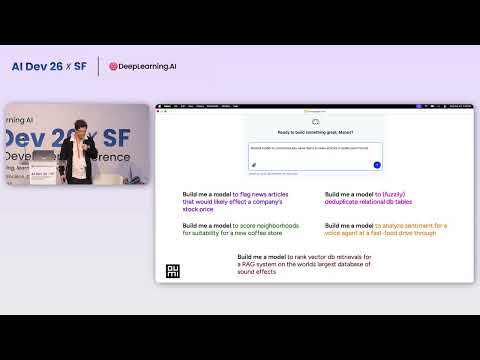
This content discusses VibeML, a platform that enables building AI models in hours, not months. Presented by Manos Koukoumidis and Stefan Webb, it highlights efficiency in AI development.

The author discusses the overwhelming number of AI models (33+) found in Google AI Studio after I/O 2026. They argue that the biggest challenge in building with AI is no longer usage, but the difficulty of choosing among so many options.
This article introduces the growing MCP (Model Context Protocol) ecosystem and highlights five essential servers for AI developers by 2026. It details the Brave Search MCP, a server enabling AI agents to access Brave's search engine efficiently without screen scraping or API key management.
Este conteúdo descreve uma abordagem simplificada para gerenciar bases de código com um agente de IA, como o Claude Code. Em vez de ferramentas complexas, o autor utiliza apenas arquivos Markdown no repositório para guiar o agente sobre as convenções do projeto, permitindo que ele gere código compatível de forma eficaz.
The author recounts rewriting their 25-year-old online bookmark manager, LinkaGoGo, with AI assistance. After initial disappointing results, they reconsidered in February, noticing a significant improvement in AI coding assistants.
O autor utilizou IA para desenvolver um aplicativo móvel, inicialmente impressionado com a velocidade para tarefas repetitivas. Contudo, a ausência de planejamento arquitetural resultou em código desorganizado, exigindo mais tempo para refatoração do que para a codificação manual.
ThumbGate introduces a system for AI coding agents to prevent errors by generating "PreToolUse" gates, with Thompson Sampling adapting their confidence. The creator describes building and marketing the product rapidly, detailing features like self-distillation and SQL protection, and noting the first sales contact originated from a GitHub issue rather than extensive social media efforts.
The article analyzes OpenAI's biggest Codex desktop update, introducing computer use on Mac, GPT-Image integration, an in-app browser, and over 90 plugins. It emphasizes that the computer use mode runs alongside users, not instead of them, contrary to common headlines.
While AI agent skills are increasingly easy to build, their practical usability is hampered by poor documentation, partial solutions, and integration difficulties. The primary bottleneck is no longer the existence of skills but the extensive manual work required to use them effectively.
The AI landscape is experiencing unprecedented growth and transformation, driven by significant industry investments and integration into development processes. The content explores record investments, AI in software development, safety, responsibility, and market dynamics.
Adit Abraham's talk at AI Dev 26 x SF focuses on enhancing the capabilities of AI agents. The central theme revolves around the critical role of data quality in achieving superior agent performance.

The title suggests frustration with the development of advanced knowledge systems, which often feel stagnant despite multiple attempts. It addresses the inherent challenges in creating and optimizing AI, where progress can be cyclical and time-consuming.
Large language models make code generation remarkably easy, but this often leads to code that developers don't understand. This lack of comprehension makes modifying, debugging, or adding features to AI-generated code challenging.

The author describes their experience using complex cloud tools for a personal AI project, LinkNibble, which led to excessive complexity and costs. They opted for a "cloud-optional" approach, moving the project to a simple, cheaper VPS to focus on simplicity and effectiveness.
This content introduces dotclaude, an MIT-licensed open-source project designed to provide a governance layer for AI-assisted development. It addresses common issues like AI assistants lacking memory of development workflows and the inconsistency this creates across engineering teams.
O autor gerencia 142 agentes de IA com identidade persistente, memória e capacidade de recusar instruções, um avanço significativo em relação aos agentes convencionais. Esta evolução levou a cinco questões cruciais de governança, que o autor agora encapsulou em uma ferramenta de diagnóstico prática.
Large language models are not automatically deterministic, often producing varying answers or filling in gaps. To improve reliability, four practical methods are suggested: prompt engineering, selecting the right model, providing appropriate context (like RAG), and utilizing tools for deterministic tasks.
pi-mono is a minimalist, high-performance TypeScript-based CLI AI coding agent, developed by Mario Zechner, which prioritizes simplicity over bloated features. It uses a unique 'differential rendering' TUI and offers efficient LLM switching and a 'YOLO mode' for enhanced developer productivity.