← heapsort-ai

Continual Learning

20 items

RESEARCHarXiv CS.LG·4/16/2026

Adaptive Memory Crystallization for Autonomous AI Agent Learning in Dynamic Environments

This research introduces Adaptive Memory Crystallization (AMC), a novel memory architecture designed for autonomous AI agents to progressively consolidate experiences in dynamic environments without forgetting prior knowledge. AMC models memory as a continuous crystallization process across a three-phase hierarchy, inspired by synaptic tagging and capture theory and governed by stochastic differential equations.

29
RESEARCHarXiv CS.AI·4/14/2026

AHC: Meta-Learned Adaptive Compression for Continual Object Detection on Memory-Constrained Microcontrollers

Adaptive Hierarchical Compression (AHC) is a meta-learning framework for continual object detection on memory-constrained microcontrollers, adapting to evolving task distributions. It employs MAML-based adaptive compression, hierarchical multi-scale compression, and a dual-memory architecture to prevent catastrophic forgetting within a strict 100KB memory budget.

28
RESEARCHarXiv CS.CL·4/20/2026

Why Fine-Tuning Encourages Hallucinations and How to Fix It

Large language models often hallucinate facts, a problem exacerbated by supervised fine-tuning (SFT) which degrades pre-trained knowledge. This research proposes a self-distillation SFT method, inspired by continual learning, to mitigate hallucinations by regularizing output-distribution drift while effectively acquiring new factual information.

27
ARTICLEDEV.to AI·24d ago

Meta-Optimized Continual Adaptation for heritage language revitalization programs under multi-jurisdictional compliance

The author realized the critical need for AI in endangered language preservation, encountering challenges like catastrophic forgetting in neural machine translation systems and complex multi-jurisdictional data sovereignty laws. The work focuses on meta-optimized continual adaptation for heritage language revitalization programs.

27
RESEARCHarXiv CS.LG·5/1/2026

When Continual Learning Moves to Memory: A Study of Experience Reuse in LLM Agents

This study investigates the role of external memory in LLM agents for continual learning, showing that the stability-plasticity dilemma resurfaces at the memory level due to limited context windows. A (k,v) framework is introduced to disentangle how experience is represented and organized, finding that abstract procedural memories transfer more reliably than detailed trajectories and finer-grained memory organization is beneficial.

27
RESEARCHarXiv CS.LG·5/7/2026

Continual Distillation of Teachers from Different Domains

This research introduces Continual Distillation (CD), a new paradigm where a student model sequentially learns from a stream of teacher models without retaining prior access. It addresses challenges like unseen knowledge transfer (UKT) and forgetting (UKF) through Self External Data Distillation (SE2D), which uses external unlabeled data to stabilize learning across heterogeneous teachers.

27
RESEARCHarXiv CS.AI·29d ago

CASCADE: Case-Based Continual Adaptation for Large Language Models During Deployment

This paper introduces Deployment-Time Learning (DTL) as a new stage for LLMs, allowing them to continually adapt from experience post-training without modifying core parameters. It presents CASCADE, a framework that uses an explicit, evolving episodic memory for LLM agents, formalizing experience reuse as a contextual bandit problem with no-regret guarantees.

27
RESEARCHarXiv CS.LG·12d ago

Architecture-driven Shift: towards a lightweight selector for capturing the trends of logit shift

This paper proposes a new lightweight selector to capture logit shift trends in Continual Learning (CL), a computationally expensive challenge in pre-trained model selection. The research addresses architectural heterogeneity in neural networks by decoupling architecture and data dependency to establish a new theoretical framework.

27
RESEARCHarXiv CS.CL·4/6/2026

Revealing the Learning Dynamics of Long-Context Continual Pre-training

Este artigo investiga sistematicamente as dinâmicas de aprendizado do Pré-treinamento Contínuo de Contexto Longo (LCCP) usando o modelo industrial Hunyuan-A13B, rastreando sua evolução por 200 bilhões de tokens. Ele propõe uma estrutura hierárquica para analisar o LCCP em níveis comportamental, probabilístico e mecanicista, abordando as limitações das metodologias atuais de avaliação e pré-treinamento.

27
ARTICLELangChain Blog·4/5/2026

Continual learning for AI agents

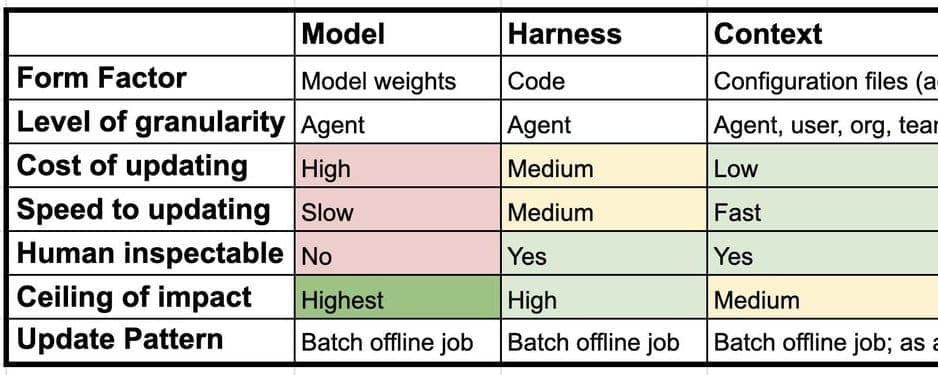
This content discusses continual learning for AI agents, proposing that learning extends beyond just updating model weights. It introduces three distinct layers where learning can occur – the model, the harness, and the context – emphasizing how this perspective changes the approach to building improving AI systems.

Continual learning for AI agents
26