How to create a full-stack app with Google AI Studio
This content outlines how to develop a full-stack application using Google AI Studio. It serves as a practical guide for creating integrated solutions with artificial intelligence.

This content outlines how to develop a full-stack application using Google AI Studio. It serves as a practical guide for creating integrated solutions with artificial intelligence.

This article explores the Chrome Dev Prompt Lab presented at Google I/O 2026, highlighting innovations in development and AI. It offers an inside look at future tools for developers.

OpenAI released GPT-5.5, a genuinely different model designed to handle complex, multi-part tasks with sustained multi-step reasoning. This iteration aims to reduce the need for constant supervision, allowing developers to trust it for planning and navigating ambiguity.
This content explores the vision of building an "Agent Native Office", focusing on the next 100 AI agents. It discusses the development and integration of intelligent agents to transform work environments.

This content explores the rapid acceleration of AI investments and integration by major tech firms, detailing its impact on software development and global market trends. It also emphasizes the critical focus on AI safety, ethical development, and responsible adoption across various regional markets.
This content refers to the 'AI Dev Zone Demo' presented at Google I/O 2026. It describes a demonstration area focused on artificial intelligence development during the conference.

This article discusses why Thai chatbots often fail due to the language's lack of clear word separation and how to build smarter ones. It delves into the principles and steps for effective Thai language processing, highlighting solutions like Rasa's DIET architecture and PyThaiNLP's newmm tokenizer for improved accuracy.
This article describes a new AI development that allows a single AI system to seamlessly perform multiple tasks like understanding images, generating text, and creating visuals, mimicking a fluid human thought process. It highlights a shift from specialized AI systems to unified, multimodal AI, exemplified by a new paper from Inclusion AI.
The author significantly reduced manual UI revisions from 4-6 to 0-2 by integrating a golden tests and Figma screenshot diff loop into their AI-driven Flutter UI workflow. Despite AI generating well-formed code, it struggled to match Figma specifications, making manual iteration a bottleneck.
A developer dramatically increased their solo velocity by running three parallel Claude Code instances, each assigned exclusive ownership of specific file directories. This strategy prevents Git conflicts and improves AI model focus by segregating tasks like Dart, SQL, and YAML development.
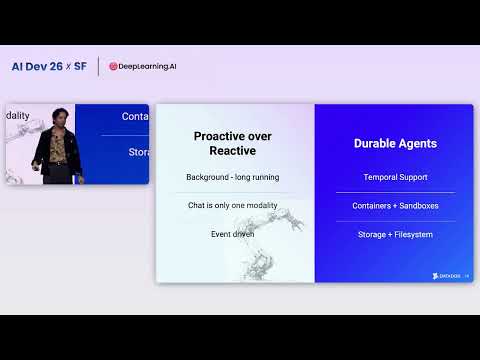
This content features Paul Everitt's presentation at AI Dev 26 x SF, focusing on the shift towards Agentic Engineering. The discussion explores how artificial intelligence is reshaping software development practices.

The era of "vibe coding" for AI startups is ending, with investors seeking Minimum Viable Companies instead of just Minimum Viable Products. The market is saturated with basic AI wrappers; funding and real traction now focus on deep, infrastructural utility and autonomous systems that remove entire categories of work.
The integration of LangChain with the Model Context Protocol (MCP) standardizes the connection of AI agents to external tools and and data, using the `langchain-mcp-adapters` library. This innovation facilitates dynamic tool discovery and multi-server connectivity, significantly enhancing the scalability and flexibility of multi-tool AI applications.
The author shares lessons from 17 failed attempts at building AI agents, revealing that only one reached production-ready status. They describe the process as chaotic and highlight the significant challenges and high failure rate in AI development.
Sara Hooker's essay "On the Death of Scaling" highlights that the trend of continuously scaling larger LLM models with more compute and data is becoming less effective. Much smaller, newer models are now outperforming their enormous predecessors, indicating a significant shift in the optimal path for AI development.
AI coding agents have revolutionized software development but often skip essential engineering practices like specs, tests, and security. The solution involves equipping AI agents with production-grade engineering skills through structured workflows that enforce the discipline of senior engineers.
A massive leak has revealed Google's "Gemini Omni," a native, high-fidelity video-to-audio multimodal model designed for real-time interaction, expected ahead of Google I/O. This next-generation AI, featuring a unified architecture, signifies Google's push in the multimodal race.
This article reveals how AI-built applications, optimized for initial speed, often fail to scale past 500 users due to infrastructure limitations and platform lock-in. It emphasizes the critical distinction between a prototype and a sustainable business solution.
The AI industry is shifting from speculative legal battles to infrastructure optimization and developer experience. OpenAI's legal win against Elon Musk validates its commercial trajectory and reduces existential risk for developers.
The author built an AI news desk for an MMA site, detailing the tech stack and the evolution of prompt engineering. They learned to avoid bot-like writing by using structured data, specific style guides, and a list of banned words.